PIF: Dead Ducks and Keep on Rolling Reviews (Paolo Kagaoan)

Planet in Focus Environmental Film Festival 2012

Dead Ducks (2012)

Directed by Brenda Longfellow

I caught a screening for the Planet in Focus film festival, beginning with a short called Dead Ducks, which is less self-explanatory than I assumed. It begins with x-rays that only shows the skeletal structure of the ducks. However, a narrator explains that their causes of death are consistent with the conditions coming with ingesting benzene that the ducks consume when they’re around the Syncrude oil sands. There are other interweaving plots in this 18 minute short. There’s one about a First Nations man driving down from Fort MacMurray to Montana, as well as one showing the painstaking care from a female-dominated society committed to rescuing these ducks. It also intermittently shows a digitized depiction of the ducks’ lives and journey south, bafflingly accompanied by a satirical a capella vocal group. These segments make the short seem off-tone, but at least the digital medium shows the ducks as vibrantly clean in a way that they can’t be in their new, polluted environment. The short’s director, Brenda Longfellow, is also a professor at York University who has enlisted the help of a few familiar local faces to play the obviously evil Syncrude honchos, delicately driving the point home that we’re oblivious to a cover-up of an ongoing environmental disaster.

Keep on Rolling: The Dream of the Automobile

Directed by Oscar Clemente

Consuming oil, as well as mobility, are the common themes Dead Ducks shares with Oscar Clemente’s Keep on Rolling: The Dream of the Automobile, which clocks in at under an hour. The movie portrays the car, a relatively recent invention in human history, and the way that it’s sold as a glamorous object instead of it being an object of doom. And if you think carmageddon is horrible here in North America, the doc shows equal nightmares in Europe. I thought the continent had its stuff together when it comes to urban planning, its old bricked pavements and historical, romantic buildings unmoved by modern technology, its vehicles small and modest as the space they inhabit. But no. It shows how cars occupy 62% of urban space and that sometimes, it takes up more space that a children’s bedroom and an office cubicle. And 62% means that cars are brushing up against baby strollers and mobility devices. This is insanely fatal. The movie argues that the car has dictated urban planning, inadvertently making neighbourhooud spaces less self-sustaining so its citizens can’t walk anywhere. It also eviscerates the car’s mythical promise of mobility, showing that if we calculate a nuclear family’s car mileages, we’ll find out that they’ve traveled the same distance as Marco Polo.

The movie has its share of melodrama, with its philosopher talking heads, as well as omitting alternative urban planning that allows cars, public transit and pedestrian spaces. However, I admit that I have made assumptions that the festival or that the connected pan-movements that it supports are anti-people. That the movie might show forests bulldozed or deserts mined so we can have our Chevys and their gasoline. But thankfully, this is an environmental documentary that loves people, that wishes that they can go out without being hit by BMWs, that hopes that we use our legs and can be in an environment where we can say hi to each other instead of honking at each other from our little wheeled jails.

Follow me on Twitter @paolocase

Like Entertainment Maven on Facebook

The Perks of Being a Wallflower Review (Paolo Kagaoan)

The Perks of Being a Wallflower (2012)

Starring Logan Lerman, Nina Dobrev, Kate Walsh, Dylan McDermott, Melanie Lynskey, Emma Watson, Mae Whitman, Ezra Miller, Paul Rudd, Joan Cusack and Johnny Simmons

Directed by Stephen Chbosky

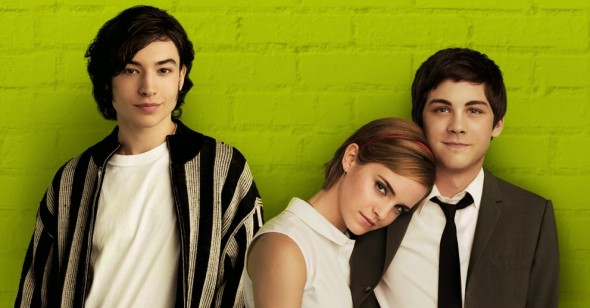
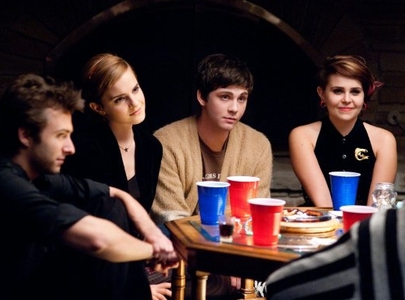
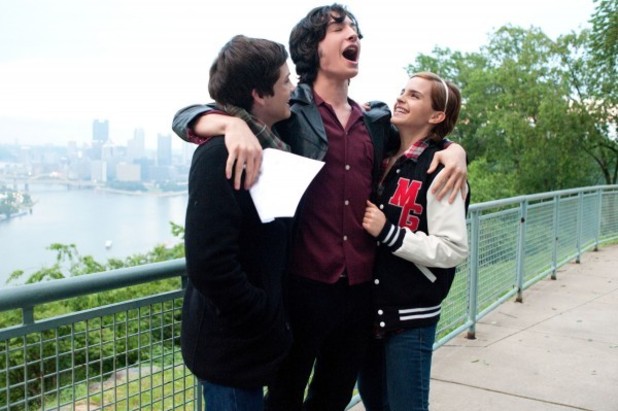
I read Stephen Chbosky’s The Perks of Being A Wallflower, the source material to the movie of the same name three years after it was published. So the memories of the book to me, which I read a decade ago, was hazy. Charlie (Lerman) to me was a kid surrounded by adults or younger versions of adults. He has a slightly acrimonious relationship with his sister (Dobrev), watches seminal television with his family (parents played by McDermott and Walsh) and has fond yet guilt-ridden memories of his dead aunt Helen (Lynskey). Because of having hospital trouble in middle school he has trouble finding friends. That’s until he found a group of the titular wall flowers like Sam (Watson) and Mary Elizabeth (Whitman) teach him the ways of Pearl Jam. Although he learns about himself in other ways, like his scientific yet exalting description of masturbation. He’ll fall in love with them and get in trouble with that and then get reintroduced with them again. And then I discovered real literature and the E! Network and I became an ironic hipster and am a lesser person for it. But Charlie keeps coming back to me in times when expected progress gets hindered by regression, just like his unnamed mental disorder that keeps returning and making him see things because he can’t resolve his past the way I can relate to.

So my first question after coming out of the movie was – where was Pearl Jam and grunge? Why are the cool kids like Sam and her gay step brother Patrick (Miller) dancing to Come on Eileen and deriding Bust a Move? Chbosky adapts his own novel for the big screen yet I still feel a disloyalty to certain aspects of his own subject. It’s like I know I’m watching a better example of a suburban teen drama but it still has to bear certain motifs of the genre. I understand these concessions. In return we have more pleasant versions of adolescent subcultures. Instead of smudged zombies, his goths look sleek and androgynous, Whitman for example performing the role as if Mary Elizabeth is a normal girl who happens to like The Rocky Horror Picture Show instead of letting her interests affect her persona.

Speaking of Mary Elizabeth, this adaptation also takes risks with casting, but that doesn’t mean they don’t pay off. The most convincing adults are Lynskey, who has played middle American women for a few years now, and Rudd, who plays Charlie’s teacher and reminds us that he can be lovable even in a platonic, mentor-ish way. Joan Cusack makes a cameo as Charlie’s doctor and it’s strange to watch her seem normal. Walsh and McDermott look more like a couple who adopts at 45 instead of having their own kids at 25 but you know Hollywood.

While reading the book I imagined a boyish freshman included in this drum circle of willowy semi-adult seniors. Instead, almost all but two of the younger cast seem like they could be the same age. One is Dobrev who has played a senior for the past half decade or so of her career. The other is Miller, whose lanky physicality reads as someone older than the rest of the kids. But the latter is an interesting case, since Patrick does have the same maturity level as the other wall flowers. And Chbosky knows that Charlie, who already knows the cracks within his family, needs to see the said maturity – or occasional lack thereof – of his older friends, so that he won’t perpetually go into hero-worship with them. As he ingratiates himself within the wall flowers he needs to see them and be seen by them as equals. Despite the alternative music and wise cracks he eventually discovers his friends’ woes. The young cast fires off at different times of the movie. There are some who instantly click, like Whitman. Others eventually prove their place in the movie, like Johnny ‘HFS’ Simmons whose perma-scowl convinces as a jock burdened with macho expectations, Miller who brings subtle amounts of laughs and sass to the group’s dynamic, and Dobrev IS the big sister to the rescue. Watson’s accent work is a bit off and might never be as good her Hermione but she makes a capable crush subject.

Since we’re already talking about cast, the most important piece in this puzzle is Lerman, whom I’ve only seen as the cocky D’Artagnan in The Three Musketeers. The first moments don’t necessarily show the exact opposite of that, and by looking at him I don’t get a teenager but strangely enough I see someone who’ll blossom as a man. These qualities are great for climbing a Sisyphean mountain, because we need to see an actor who we can have a puppy crush on, can say something mean without being mean, and can throw a punch, instead of someone more clownishly vulnerable. And with payoffs his performance in the last scenes are the most rewarding, the camera cutting and weaving through his jagged trauma. Despite Chbosky scrubbing the dirt and profanity off his own material, these last scenes take us to a movie that’s as dark in different yet equally cathartic ways as the book is.

Follow me on Twitter @paolocase

Like Entertainment Maven on Facebook

TIFF 2012: Clip and Picture Day Reviews (Kirk Haviland)

Photo from http://www.tiff.net

Clip (2012)

Starring Isidora Simijonovic, Vukašin Jasnic, Sanja Mikitišin, Jovo Makisc and Monja Savic

Written and Directed by Maja Milos

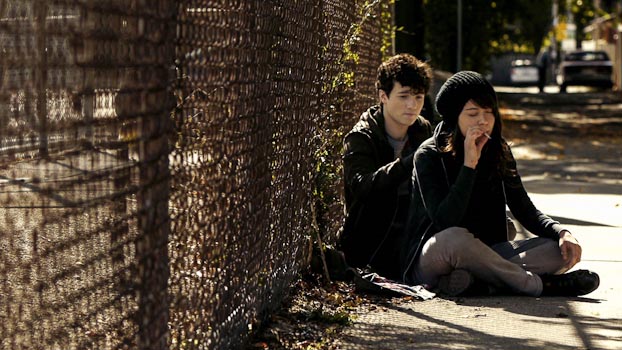
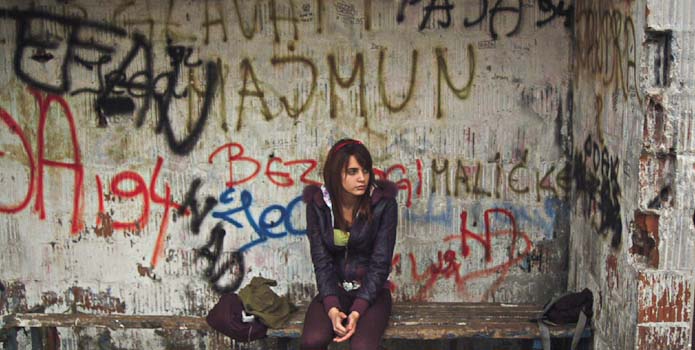
Jasna (Simijonovic) is a teenage girl living in the poor suburbs in the south of Belgrade, Serbia. She, like many girls her age, likes to record everything around her using a mobile phone camera. She is making videos of herself, her school friends, family and Djole (Jasnic), the boy of her dreams. Her family life is a mess, her father is terminally ill and mother is barely coping. Jasna cannot figure out how to cope with this and it leads her further down the wrong path, leading to more and more time hanging out with her school friends, partying and drinking. At one of the parties, she finally starts a conversation with Djole and later they develop an intense sexual relationship. When he realizes that she will do anything to be close to him, Djole starts using her as a sexual object. Jasna starts experimenting heavily with drugs and her life starts spinning out of control and who knows if she’ll ever find a way out.

Photo from http://www.tiff.net

Director Milos pulls no punches in her portrayal of entitled children who bury themselves in drugs and alcohol without any thought of consequence from their actions. Simijonovic does a decent job in her acting debut, in fact most of the cast was on their first film set and sadly it shows. The plot meanders and the story of the family is simply there to try and explain Jasna actions, but is never elevated enough to have an impact on the story for the viewer. In fact the story is dropped for periods at a time and is never brought to a conclusion. Jasnic’s performance as Djole works more than it doesn’t, but also shows all the earmarks of an inexperienced actor. Milos shows she has done a lot of research and has a good eye for staging and a steady hand behind the camera, she is someone to keep an eye on, but the uneven results leave the film wanting. Clip is a mild non-recommend.

Photo from http://www.tiff.net

Picture Day (2012)

Starring Tatiana Maslany, Spencer Van Wyck, Steven McCarthy, Susan Coyne, Fiona Highet and Mark DeBonis

Written and Directed by Kate Melville

Claire Paxton (Maslany) is a teenage girl who is forced to repeat her last year of high school due to bad grades and absenteeism. Claire still prefers to cut class whenever feasible and spends her nights clubbing, living on the fringes of the adult world she’s almost part of. Two men enter Claire’s life and shake things up enough to confuse her idea of what she wants out of life. James (McCarthy), the singer in a popular Toronto faux-funk band, is intrigued enough by Claire that the reveal of her age does not sway his pursuit. Claire is also the enamored object of another’s affection, her former babysitting charge Henry (Van Wyck), a shy, geeky science whiz who keeps shoe boxes full of mementos, most of them relating to Claire. After a chance meeting and a shared blunt, Claire is determined to help Henry get noticed at school, hardly difficult since she’s already infamous.

Photo from http://www.tiff.net

Picture Day is a small intimate story that relies on the chemistry and like ability of its two main leads Maslany and Van Wyck. Maslany is our main focus overall, she’s in almost every scene, and proves that she’s more than capable of the pressure. She is fantastic in the role and has the audience falling for her character despite her sexually freewheeling ways and path to self-destruction. Van Wyck is charming enough to stay involved for the viewer and to follow his story, but this is Maslany’s film from the get go. Writer/Director Melville crafts a smart script with a real character as its lead. Maslany’s Claire is multi-layered and complex, with a tough exterior that has been hardened by disappointment, but a clear vulnerable center. The setting is excellent and the City of Toronto easily becomes another character in the film as Melville imbues it with personality and charm. Picture Day is a solid recommend.

Till Next Time,

Movie Junkie TO

Make sure to keep up with what’s going on at Entertainment Maven by liking our Facebook page and having updates delivered right to your Facebook News Feed. It’s the only way to stay on top of all of our articles with the newest blockbusters and all the upcoming films, festivals and film related events in Toronto.

Follow me directly on twitter @moviejunkieto and by liking my Facebook page at Movie Junkie TO

Email me at moviejunkieto@gmail.com

Keep The Lights On Review (Paolo Kagaoan)

Keep The Lights On (2012)

Starring Thure Lindhart and Zachary Booth

Directed by Ira Sachs

This is the gay world in 1998 in New York City, where the clubs were gritty, a community feeling the major effects of HIV, when bathhouses and sex clubs are illegal, a world that has yet to discover Manhunt and Grindr. And since those are the other circumstances and ways that gay people live and meet each other, there are also the hotlines like the one used by Eric (Lindhart), Keep the Lights On’s protagonist. Originally from Denmark, he speaks with this gravel-y accented voice that becomes funnier the longer we hear it because of how ridiculous the performative aspect of sexuality is. Eventually he hits a few home runs, one of whom is a younger looking man named Paul (Booth) who works in publishing and has a girlfriend. But even if these hookups seem temporary on the surface, a mix of pure will and serendipity means that he’ll meet these men again, especially Paul, who makes him feel what he believes is real love.

As romance stories go, trouble looms, and it looms shockingly early in this movie. Eric’s second stay at Paul’s apartment involves shared drugs, and what seems like recreational use becomes an addiction. This will probably sound judgmental but I still have rules about relationships. Since I’ve broken so many already, I still have a drug rule which is don’t do drugs, that’s the rule. At the same time, we as an audience should understand that just like in life, fictional characters can’t choose who they end up loving. It’s easy to dismiss people as strangers instead of accepting them and helping them work out their flaws. Eric has the same approach in the movie, the humanistic one. As he lets Paul into his life, we also remember how rampant drugs are within the community, and our – projecting – defenselessness to a difficult issue that no one can or wants to solve. Eric equally has a hand within the problem, taking drugs recreationally with and without Paul.

Although drugs and their effects take a brutally central place here, it’s not the only aspect of the story that we see. The movie takes place within sections of an eight year span, most of which Eric uses to direct a documentary. In between ‘work’ he goes on road trips to cabins with his friends, the latter of whom surround him. An aspect I’ll never get about most romantic movies is how one-sided the story is, in this case only showing Eric’s bourgeois milieu. Except for the occasional supervisor, we don’t get to see Paul’s peers. By keeping Paul at an arm’s distance the movie lets its audience assume that all his friends are drugged up rent boys. Although I do feel that by showing less of Paul’s side of the story, the movie becomes less overwrought. Despite this problem, Booth’s performance, as well as Lindhart, shows the urgency of their problem. And we don’t have to necessarily see both men as representatives of the community and instead, it allows us to see them as human beings capable of love and broken so that they can’t fully enjoy it.

Follow me on Twitter @paolocase
Like Entertainment Maven on Facebook

Sinister Review (Kirk Haviland)

Photo courtesy of Alliance Films

Sinister (2012)

Starring Ethan Hawke, Juliet Rylance, Michael Hall D’Addario, Clare Foley, Fred Dalton Thompson and James Ransone

Written by C. Robert Cargill and Scott Derrickson

Directed by Scott Derrickson

In theaters this weekend from Alliance Films, just in time for Halloween, we get the newest horror title from director Scott Derrickson, the director of the Exorcism of Emily Rose. With the mainly lackluster theatrical year we have had to date for the horror genre, Cabin in the Woods withstanding, the real question is can Sinister deliver where others this year have failed? And can one of us, online film Critic C. Robert Cargill, aka Ain’t it Cool News’ Massawrym, really write a film that lives up to the hype?

Ten years ago, true crime writer Ellison Oswald (Hawke) made his reputation with a best‐selling novel based on a notorious murder. Now, desperate to replicate the critical and financial success of that book, he moves his loyal wife (Rylance), none too happy son (D’Addario) and daughter (Foley) into a home where a suburban family was brutally executed and a child disappeared. Not telling his family of the home’s past, hoping to find inspiration in the crime scene, Ellison discovers a mysterious box containing Super 8 footage of a series of murders, including the ones from the house. Rather than going to the local authorities and reporting the find, he keeps the movies to himself and takes on an unassuming Sherriff’s Deputy (Ransone) to unwittingly do his research, hoping to publish another acclaimed book based on these series of crimes. As Ellison starts to piece together the truth behind the horrific images on the films, unseen intruders and inexplicable goings‐on disrupt his once peaceful household.

Photo courtesy of Alliance Films

Sinister works because it focuses less on simply staging a line of jump scare tactics, and more on building tension while never hitting the release valve. The script is smart and tight, although it’s not entirely original in that it uses and falls prey to some of the most obvious of horror conventions, but it also uses them more effectively than most. Ethan Hawke does some very solid work here, the level of paranoia involved with his performance adds to the building sense of dread surrounding the family in the film. The rest of the cast does admirable work as well, the child actors in particular show they can hold their own amidst the veteran actors. Ransone’s deputy may have been the hapless goofball in any other film, but he and the script give the character some surprising depth and even a more level head than the deteriorating Oswald can muster.

The score is brilliant and unnerving, building layer upon layer as the film progresses and tensing up the audience as it goes along. Director Derrickson proves that he may be best suited for genre pieces as this is a giant step forward from the abysmal Day the Earth Stood Still remake. Sinister is far from perfect mind you. Can Oswald please stop bumbling around in the dark and just turn on a light? And seriously, does every character here sleep like they are dead? You figure with the crashing, falling and multitude of other actions going on in the house somebody else in the family would wake up. But taking the good with the bad the film is still miles above most of the genre fare we have seen in multiplexes this year. The villain of the piece could have been an awful campy nightmare, but instead it works brilliantly. My only qualm is with the last shot of the film, when the film has already been wrapped up nicely, we get what appears to be an unnecessary studio addition. Also we get a way too brief appearance from an un-billed star that I will not mention other than to say I wish it was much longer.

Photo courtesy of Alliance Films

Sinister is successful because of its ability to develop and sustain atmosphere and tension for its almost tw hour running time, a feat in its own with the amount of 85/95 minute disposable genre films we are subject to most of the time. Sinister is a very solid recommend, go out and see it this weekend.

Till Next Time,

Movie Junkie TO

Make sure to keep up with what’s going on at Entertainment Maven by liking our Facebook page and having updates delivered right to your Facebook News Feed. It’s the only way to stay on top of all of our articles with the newest blockbusters and all the upcoming films, festivals and film related events in Toronto.

Follow me directly on twitter @moviejunkieto and by liking my Facebook page at Movie Junkie TO

Email me at moviejunkieto@gmail.com