Haywire Review

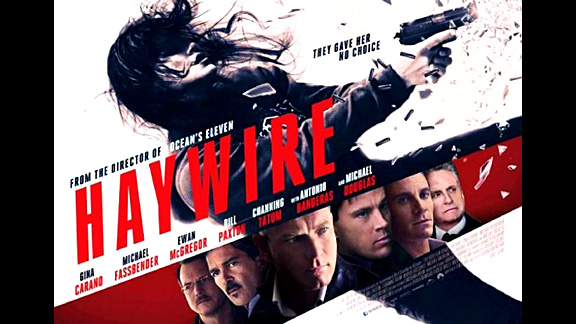
Steven Soderbergh’s latest film Haywire is clearly a vehicle for MMA star Gina Carano’s entrance into the world of action films. As far as action stars go, Carano seems to fit the bill. She’s quick, strong, charismatic, and attractive. She can also roundhouse a bad guy in the face with tremendous ferocity, or if the fight goes to the ground, she has a handful of submission moves to make her opponent look like an oversized rag-doll. Add to this an all-star cast featuring the likes of Ewan McGregor, Michael Fassbender, Channing Tatum, Michael Douglas, and Antonio Banderas, and you would think that Haywire would be a certain success. Unfortunately this is not the case, as Haywire stumbles out of the gates and never even approaches an entertaining action movie, let alone a coherent narrative.

Carano’s debut into the world of features films can be viewed as a success if isolated from the rest of Haywire. Her acting and dialogue delivery may need some work, but her coquettish facial expressions mixed with her volcanic fighting ability make her an interesting action star, not simply a one-dimensional cardboard cut-out. In addition to Carano’s onscreen presence, the fight scenes are often fairly good, especially one with Fassbender in which Carano’s strikes appear to be absolutely bone-crunching. However, these positives are too few and far between given that the script appears to have been written by a dozen monkeys randomly banging away at a keyboard.

I may be exaggerating regarding the script, but only slightly. Haywire should have been a no-brainer. A film that audiences could walk into and lose themselves in the action for ninety minutes. Unfortunately, Haywire thinks it’s an intelligent action movie, but it is anything but. Constant location changes (Dublin, Barcelona, USA) and relentless references to off screen characters (Rodrigo, Kenneth, Paul), imply that quantity is equivalent to an intelligent plot, but the complexity turns out to be simply boring and confusing. At no point does Haywire even come close to a coherent narrative. I don’t even feel like getting into the incredibly ineffective Jazz soundtrack or the snail like pace created by Soderbergh. For me, if a film doesn’t even attempt to have an interesting story, then I am not interested in the other details, they are simply incidental.


A Really Bad Play – Hilarious theatre in Toronto

If you live in Toronto and have the January movie theatre blues, then get your ass off the couch or out of the multiplex, and make your way down to The Pia Bouman Theatre (Tuesday, January 31st – Saturday, February 4th) for A Really Bad Play, one of the most hysterical, side-splitting, ROFL plays out there.

The play is written and directed by rising comedy star Daniel Stolfi. Fresh off his incredibly successful one-man show, Cancer Can’t Dance Like This, for which he and his team received a Canadian Comedy Award, Stolfi has decided to tackle the world of bad theatre. He is not so much satirical, or tongue-in-cheek, instead Stolfi has written a piece of theatre that is an assault on the funny bone and could double as a trip to the gym, as audiences will be literally trying to catch their breathe in between laughs. A Really Bad Play also features an incredibly talented and experienced cast (Shawn Ahmed, Jessie Gabe, Ryan Allen, and Trevor Small) who manage to make Stolfi’s excellent writing even better through their performances.

For $15 dollars in advance or $20 at the door it’s really a no-brainer. Get out and see Stolfi now before he goes the way of previous talented Canadians and is snatched up by our neighbours with the deep pockets.

A Really Bad Play is the perfect cure for the January blues.

TICKETS

A Really Bad Play (Facebook)

Cancer Can’t Dance Like This


A Dangerous Method Review

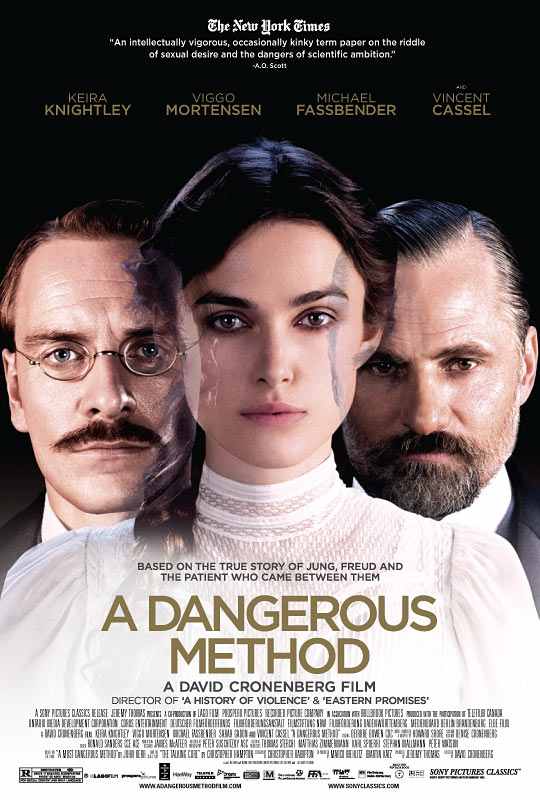
It seems like David Cronenberg had taken a brief hiatus from the film world following A History of Violence and Eastern Promises, two films which are truly unsettling thanks to their depiction of cruel and sometimes indifferent violence in the world of organized crime. Cronenberg returns with A Dangerous Method, a decidedly different story from his past two films, with a focus on the cerebral and the emotional world of psychologists and those afflicted by mental illness.

A Dangerous Method is about the relationship between Carl Jung (Michael Fassbender) and Sigmund Freud (Viggo Mortensen), two of the most important figures in the history of modern psychology, and as a result probably one of the most interesting relationships between two individuals in the past hundred years or so. The contrast between their beliefs and character could not be more emphatic. Jung is a young man, open-minded, and has a generally positive outlook regarding the human mind; Freud on the other hand is an older man, certain about the importance of his theories, and satisfied that the underlying cause of neurosis is always sexual in nature. These notable differences make it easier to understand how upon meeting, these men famously had a conversation which lasted thirteen hours. In addition, the relationship between Jung and Sabina Spielrein (Keira Knightley), one of Jung’s patients, also takes centre stage in A Dangerous Method. Spielrein is a fiercely intelligent woman with a debilitating mental illness which Jung finds fascinating. The circumstances surrounding these three characters provide more than enough content for an intriguing story, unfortunately the final product comes off as a little dull and severely hampered by one character/performance in particular.

Fassbender and Mortensen do a remarkable job in their portrayals of these intellectual giants. Their onscreen meetings are enthralling and often contain amusing humourous moments. The best scenes in the film are those in which Jung and Freud discuss their unique views and theories which cascade across the dialogue for the enjoyment of audience members with an interest in psychology.  Many viewers familiar with Jung and Freud will recognize some of the pairs most storied discussions about dream analysis and one in particular about occult powers. Despite these intriguing scenes, the narrative in A Dangerous Method does not seem properly suited for film. The story often slows to a crawl thanks to the fact that much of the communication between these two men was in the form of written correspondence; be prepared for plenty of letter reading and writing scenes. Finally, any hope of salvaging what was probably a much better book than film is lost thanks to the otherworldly performance by Keira Knightley as, apparently, the single most neurotic person to have ever walked the earth.

I wasn’t familiar with the real life character of Sabina Spielrein going into A Dangerous Method, but if she was anything like Kiera Knightley’s portrayal, then this is further reason to tell this story in a book rather than a film. Knightley is onscreen for the majority of the picture, and most of her time is spent screaming, crying, thrashing about, and just looking downright tormented. Dynamics and niceties have been ignored in favour of a frontal assault on the senses. Hints of Spielrein’s intelligence can be found only at the level of the screenplay and are not communicated through Knightley’s acting. She looks to be in the running for over-actor of the year with this excruciatingly abrasive performance that is accompanied by a Russian accent which goes on and off like a strobe light. In the end, she is hugely distracting and manages to topple a film which was already on unstable ground.

The Girl with the Dragon Tattoo Review

‘Remake’ is such a dirty word, but one that many feel defines a large portion of Hollywood releases these days. I’ve seen comments on film review blogs castigating the reviewer for calling a particular film a remake because it was in fact a re-envisioning based on the same material, or in the case of 2011’s The Thing, a prequel. Perhaps these comments are ‘technically’ correct, and some of these films that feel like remakes do not fit the definition; however, language is not perfect. When I hear the word ‘remake’, I do not think of a rigid definition that only encompasses films that are strict recreations of previous films. No, I think of films that draw heavily on previous material, often trying to revive the soul of exciting stories that used to light up dark theatres to the applause of excited viewers, but have since been relegated to the shelves of DVD collections.

For a film to be a remake in my opinion, the filmmakers need not take much: a name, Freddy Krueger (A Nightmare on Elm Street), a situation, living next-door to a homicidal neighbour in Disturbia (Rear Window); or even just some thing (The Thing). Borrowing from a movie or paying homage is commonplace in original screenplays, but utilizing a critical aspect (call it the soul or the backbone) of a previous work will forever be what remakes are made of in my eyes. As I have said, language is not perfect, and at the moment we don’t have a better or more commonly used word to describe the type of films I’m speaking about. That said, on to my review of the remake of The Girl with the Dragon Tattoo.

This time around director David Fincher deals with the same material that Niels Arden Oplev worked with for Sweeden’s 2009 version of The Girl with the Dragon Tattoo (TGWTDT). Based on the book of the same name by Stieg Larsson, TGWTDT tells the story of journalist Mikael Blomkvist (Daniel Craig) who it seems has just been unceremoniously sued for libel by a powerful businessman as a result of one of Blomkvist’s investigative articles. In turn, the suit has completely emptied Blomkvist’s savings account. However, ss luck would have it, it is only a matter of days before Blomkvist is offered a lucrative job to solve a 40-year old murder. Aided by Lisbeth Salander (Rooney Mara), a troubled, anti-social, and brilliant computer hacker, Blomkvist sets out to solve the mysterious murder, encountering plenty of resistance at every turn from the pack of vipers that make up the murdered girl’s extended family.

The remake of TGWTDT is really quite a solid movie. The acting was fairly good across the board with Mara and Craig turning in great lead performances. Although there were a few awkward moments in which Craig would yell, one particular bellowing of the word ‘cat!’ sticks in my mind and struck me as quite odd. I don’t really remember Mara from The Social Network, but her performance in TGWTDT will stick with me for all the right reasons. She was not quite as effectively withdrawn and robotic as Noomi Rapace in the original film, but did a great job as Salander, and brought more sex appeal to the role (not that this was necessary, but it worked).

Not surprisingly, Fincher puts his talent to work and manages to make some of the more darker and grisly parts of the original even more so. Although it should be said that this was by no means a weakness of the original, Fincher just does it better.

Finally, the relationship between Fincher and Trent Reznor of Nine Inch Nails continues in TGWTDT, a la Seven, with an uncomfortable opening sequence depicting human bodies, made of some black liquid, interacting with and assimilating each other, while computer cables and cords protrude from and intertwine with the bodies. This imagery is accompanied by a Nine Inch Nails cover of Led Zeppelin’s Immigrant Song, with Karen O of the Yeah Yeah Yeahs on vocals. The bizarre imagery and hard acoustics may not be the most appropriate for TGWTDT, it’s not as dark as Seven, but openings of this quality are always enjoyable.

Having now seen both versions of TGWTDT (the original when it was out in theatres), I think it would be nitpicking to say one version is superior to the other. The stories are nearly identical as far as I can tell. The acting is quite good in both versions. The run times are both very lengthy, the original was 152 minutes while the Fincher version is 158. Not considering the context of the why the Fincher version was made, I have to say that it is quite a good film. TGWTDT is suspenseful, intriguing, visually gorgeous, and at times horrifying. New viewers should most certainly make it out to the theatres for this one. For those who have seen the original, I would only recommend a viewing if you are particularly fond of TGWTDT or the work of Fincher. In the end I still have to wonder, with the release of the original just a couple of years behind us, why was the Fincher version was even made? For money I suppose.

That always seems to be the answer.

Double Bill at the Projection Booth (Dec. 13th) – ‘Little Terrors Short Film Series’ & ‘Christmas Evil’

Hand drawn art from Kevin Hutchinson (www.secondskincreations.net)

The next edition of Little Terrors is right around the corner. If you haven’t had a chance to check out this incredibly fun monthly series of short horror films, do not wait another month! The press release is below:

Toronto genre fans looking for a little bit of Holiday‐themed mayhem should visit THE PROJECTION BOOTH (1035 Gerrard Street East) on Tuesday, December 13th. On the docket: a double shot of terror for one ticket price! First up, Rue Morgue & Unstable Ground’s monthly short film series, “Little Terrors”, returns for it’s sixth month, starting at 8pm. Then, at 10:30pm, catch director Lewis Jackson’s cult‐classic horror film “Christmas Evil” on the big screen!

We invite you all to this licensed event!

Full Details:

Rue Morgue & Unstable Ground present Little Terrors – Vol. 6 – Holiday in Hell
December 13th @ 8pm, The Projection Booth
https://www.facebook.com/events/236578163076326/
http://www.blogto.com/events/49223
http://www.unstableground.net/littleterrors6.jpg

Christmas Evil
December 13th @ 10:30pm
https://www.facebook.com/events/302400839781089/
http://www.blogto.com/events/49224
http://www.unstableground.net/christmasevilscreening.jpg

Advanced Tickets (also available at door):
http://guestlistapp.com/events/80715

Little Terrors on Facebook:
https://www.facebook.com/littleterrorstoronto

Supporting links:
http://www.rue‐morgue.com
http://www.unstableground.net
http://projectionbooth.moonfruit.com/
https://www.facebook.com/ProjectionBoothEast