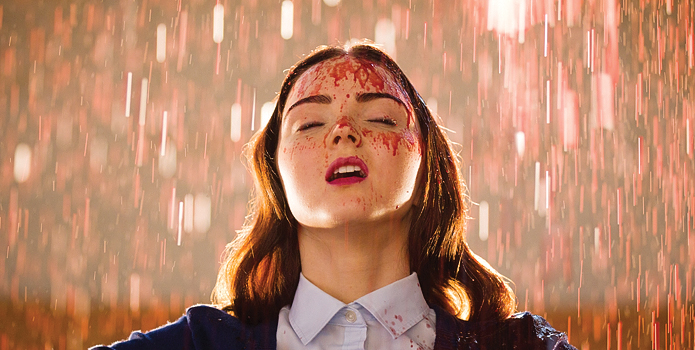
Lovely Molly Review (TIFF 2011) – From the director of The Blair Witch Project

Image is not the property of Entertainment Maven

Lovely Molly is the continuation of director Eduardo Sánchez’s experiment with first person horror, the initial part of the experiment being The Blair Witch Project. However, the majority of the film is not shot from the first person point of view, unlike Blair Witch. The technique is used sparingly and primarily for time spent alone by the main character in and around a creepy country home. The experiment is hit and miss, as Lovely Molly has enough genuinely scary moments to make it worth a view for horror fans, although the first person moments tend to detract rather than add to the film. I felt lost in the narrative during many of these moments, perhaps it is my fault for not engaging the film enough. The importance of these scenes became apparent near the end of the film, but served only to confuse before that.

The film tells the story of Molly (Gretchen Lodge) and her new husband Tim (Johnny Lewis), as they move into Molly’s childhood home to start a life together. It isn’t long before unsettling events, possibly supernatural in origin, begin to happen in the home. Molly finds it harder and harder to spend time alone in the home at night.  Truck driver Tim is constantly on the road for days at a time, and Molly’s sister Hannah (Alexandra Holden) tries to help, but can’t hold her hand every step of the way. Add to this, disturbing forgotten memories that begin to surface in Molly’s mind and a struggle with a serious drug abuse problem from the past, and it is apparent that Molly faces a battle for her sanity that may be impossible to win.

SPOILERS

I don’t know why Sánchez is so enamoured with the first person POV. These scenes were interesting at times during the film, but I thought he did a much better job with the traditional views comprising the rest of the film. Sánchez did a wonderful job building the tension of the suspenseful scenes, waiting just enough time to be exciting, but not so long that the tension was unbearable. Also, ghastly sound effects were used masterfully to indicate a potentially malevolent presence in the house. A deep resonating voice calling to Molly was accompanied by the buzzing of flies made me wish I was elsewhere at that particular time.

Another strength of Lovely Molly is the treatment of the real and the imaginary. Out of all the films that I have seen at this year’s festival that have tried to blur the line between fantasy and reality (Intruders and The Moth Diaries), Lovely Molly does the best job of it. I was flip flopping back and forth the entire film as to whether I expected the horror to be a result of mental illness or an actual supernatural haunting. Unfortunately, this also lead to one of my biggest gripes about the film. The end of the film feels rather ambiguous, despite some clear evidence regarding the nature of the horror. This is a legitimate way to end a film, but some of the storyline decisions that lead up to the finale felt kind of clumsy. It feels like many scenes in Lovely Molly were included because they would look cool or be scary as hell, rather than fit in nicely with the ambiguity of the story. It feels like 10-15 minutes of narrative were cut from the film that would have helped to explain some aspects of the storyline and set the scene for a successful ambiguous ending. Why the discovery of the sigil beneath the floorboards? Why the horse head imagery? During the Q & A session Sánchez said that the goal of the ending was ambiguity, although I think this choice of path could have been the result of a somewhat weak script.

Finally, the performances turned in by the cast were quite good, with Gretchen Lodge as Molly taking centre stage. Sánchez called Lodge his discovery and I would agree with him. Lodge turns in a masterful performance, transforming from a happy newlywed into a deeply disturbed individual. Lodge should consider some H.P. Lovecraft adaptations if they ever make it onto the big-screen. She also impressed with her bravery standing on stage during the Q & A. Brave, considering her character had a strong dislike for clothing for a large portion of the film.

Lovely Molly is a genuinely scary horror film, although it feels a little more like an experiment than an actual story, and the ending feels like a bit of a cop-out. I’m sure there are some people out there that thought the ending was brilliant, and maybe it is, I’m just relaying my feelings after one viewing of the film. Despite it’s flaws, I would recommend Lovely Molly for the scary moments delivered by Sánchez and for Lodge’s performance. It’s not very often that horror films have acting of this quality.

Intruders Review TIFF 2011

Image is not the property of Entertainment Maven

I think the horror genre often gets accused of not having anything important or interesting to say about real issues in the real world. I know that some genres are better suited for discussing serious issues, but sometimes a topic comes along that the horror genre has a claim to. Juan Carlos Fresnadillo’s Intruders explores one of the more fundamental aspects of human nature, the birth and promulgation of fear. More specifically, the passing of specific fears from parents to children. I think that parents take too much blame in today’s society for how their children turn out, but a few issues, such as religious indoctrination, anxieties and certain types of fear are without a doubt often passed on from parents to children, and they likely need to take more responsibility for these dubious family heirlooms. This is the topic and the message of  Intruders, it is both an urgent and intelligent issue.

The film follows two interwoven narratives. One part of the storyline takes place somewhere in Spain, and follows a young boy and his mother as they are terrorized nightly by a supernatural being named ‘Hollow Face’, who would like nothing more than to rip off the young boy’s face and make it his own. The other segment of the film centres on John Farrow (Clive Owen) and his twelve-year-old daughter Mia (Ella Purnell). One day at her grandparents country home, Mia makes quite the discovery as she finds an aged unfinished children’s story in the hollow of an old tree. Unfortunately for Mia, the story is about the legend of Hollow Face, and not long after reading the story, Mia finds herself the victim of Hollow Face’s latest attempt to steal the face of a child.

Intruders is not a straight horror film, and really belongs in the psychological horror sub-genre. It is a mature horror film, but unfortunately the scares and horror do not feel as mature as they should have been. That being said, Intruders does a marvelous job of blurring the line between fantasy and reality. Even though I have alluded to the transmission of fears from parent to child, Intruders will keep you guessing about the true nature of Hollow Face until the final scene.

The acting is solid all around, with Clive Owen doing a particularly good job, although I’m sure many viewers already expect this of him. Hollow Face looks quite creepy at times and rather mundane at others, as he takes different forms throughout the film. I can’t help but feel that his most successful appearance was his introduction, climbing scaffolding at night and looking reminiscent of ‘Death’ from Peter Jackson’s The Frighteners. However, some encounters with Hollow Face could have been more frightening. Many times the film is too dark to see what is going on and unfortunately this may take some viewers out of the story, as they try to figure out what is happening onscreen.

In the end, the true strength of Intruders is that it is an intelligent horror film. The film makers and distributors may have some important decisions to make as they decide how to market a smart adult horror that is a little short on the actual horror. The next time someone says that horror films are brainless, turn them onto Intruders, although those looking for something horrifying may have to look elsewhere.

Sleepless Night Review TIFF 2011 (Nuit Blanche) – An evening of action and thrills in a Parisian nightclub

Image is not the property of Entertainment Maven

In a previous online interview, the programmer of Midnight Madness, Colin Geddes, said his two picks for films that may surprise some people were Sleepless Night (Nuit Blanche) and The Day. Based on this recommendation, I was very anxious to view Frédéric Jardin’s Sleepless Night because the films at Midnight Madness had taken an inevitable dip in quality from the non-stop excitement of The Raid and You’re Next, although it should be said that every single film has been interesting in its own right. Nobody knew anything about this Sleepless Night going in. Tomer Sisley, the lead actor, even told us so during the introduction, with a smirk on his face and in a slightly arrogant manner. The man certainly seemed confident in the film. Did he have reason to be?

Sleepless Night begins with the credits rolling in reverse. It turns out they are gliding over the hood and roof of car speeding through the streets of Paris. Intense music and balaclavas let the audience know that Sleepless Night isn’t going to hold their hand, but will rather force them into the narrative, ready or not. Two crooked cops, Vincent (Tomer Sisley) and Manuel (Laurent Stocker), rip off some small time thugs for a gym bag full of cocaine. The drugs belong to Marciano (Serge Riaboukine), an established criminal that operates out of his nightclub, Tarmac. Before we have a chance to get comfortable, Marciano has identified Vincent as one of the thieves that ripped him off, and has kidnapped Vincent’s teenage son, Thomas (Samy Seghir). The remainder of the film sees Vincent running and fighting his way through the nightclub, trying to evade Marciano’s henchmen as well as undercover internal affairs officers, all while trying to save Thomas.

Sleepless night reminds me of hugely entertaining non-stop action-thrillers like Taken and Edge of Darkness. Sure, the characters played by Liam Neeson and Mel Gibson have a serious problem NOT killing people, that Sisley’s Vincent does not seem to share, but the allure of the films is the same, adrenaline pumping tension and action. What separates Sleepless Night from other films of the same ilk, is that the action and use of force escalates at a very gradual and realistic rate. Words are initially the primary vehicle of the suspense and action, followed by fists and feet, and then finally bullets. It’s refreshing to see a hero not come out ‘guns a blazin’ when the odds are stacked so heavily against him.

The nightclub works perfectly for the setting of the film. I love it when single locations are utilized effectively for nearly entire runtimes. Unnecessary and copious scene changes require work from the audience and often detract from the narrative. Marciano’s nightclub, Tarmac, with its variety of rooms and patrons provides an excellent environment for the struggle between Vincent, Marciano and the internal affairs agents. Effective cinematography and music also help convey the confusion and tension of the predicament that Vincent has found himself in. The camera work even has a bit of a French Connection realism feel at times.

It was great to see Sisley before and after the film. He had his phone out taking videos of the fans in line and then their reactions at the end of the film. He looked like a kid in a candy store. It’s only at film festivals where you can see a sight like that and get an idea of how much satisfaction film makers and actors can derive from a successful screening. The best way to describe Sleepless Night is probably as a ‘cops and robbers’ chase that doesn’t let up until the final credits roll. Congratulations to Jardin and crew for creating a very entertaining film. Check this one out if you get the chance!

The Moth Diaries Review (TIFF 2011)

Image is not the property of Entertainment Maven

Here at Entertainment Maven my focus is to find and recommend the best entertainment out there. These films, books, games, etc. find themselves on the ‘Entertainment Maven Seal of Approval’ page. Everything that doesn’t make the cut is not necessarily a bad product. Plenty of enjoyable films that I have reviewed did not receive the seal of approval, mainly because they were not outstanding or had some issues holding them back. In these instances I take pride in discussing the positives and negatives of the film, and attempt to provide constructive criticism. Unfortunately, it would be an effort in futility to find something positive to say about Mary Harron’s The Moth Diaries.

Harron is known for a number of popular films, such as I Shot Andy Warhol, American Psycho and The Notorious Bettie Page. I’m a big fan of American Psycho and was anxious to see what Harron would do with a Vampire story in an all-girls boarding school. The story follows Rebecca (Sarah Bolger) as she returns to boarding school and the friends that she has met there over the past two years. The new semester gets off to a rocky start, as Lucie (Sarah Gadon), Rebecca’s best friend, begins to hang out with the creepy new girl, Ernessa (Lily Cole). Ernessa is tall, deathly pale, has dark hair, can read Latin and Greek, speaks perfect German, can’t swim, causes fresh flowers to die, and doesn’t appear to eat anything. SPOILER alert for people with a short term memory so brief that they cannot remember my last sentence; she’s a vampire.

The topic of vampires is broached in the most subtle of manners, as Rebecca’s English literature class discusses the topic daily. Lucie even plays the near identical role of Ms. Lucy Westenra, from Bram Stoker’s Dracula.  Perhaps subtle wasn’t the right word to describe The Moth Diaries treatment of vampires. The remainder of film feels like a prank reality TV show, as the audience sits and ponders why they spent over twenty dollars on a slew of vampire cliches and one-dimensional characters that couldn’t even startle pre-teens with anxiety disorders.

This review may seem rather venomous, but I am insulted that The Moth Diaries pretends to have anything intelligent to say about tragedy, suicide, friendship and family. I would love to go back and time the interactions between the characters, most cannot have been more than 15-30 seconds. These cardboard cutouts just don’t have anything important to say to each other. Scene transitions are clumsy and ineffective. A span of 60 seconds will see night turn to day and then back to night in the most haphazard fashion. The film reaches the height of ridiculousness when Rebecca and her 30-plus year old English teacher romantically embrace. The surprise and frustration of the audience was palpable. Where were the precursors to this moment?

The TIFF programming I have experienced this year has been fabulous. It was inevitable that a film like The Moth Diaries would slip through the crack at some point. With some editing of the mature content (some nudity and scenes of violence), I’m sure that The Moth Diaries could be used by Child Psychologists to successfully rid toddlers of nightmares.

The Incident Review (TIFF 2011) – Since retitled as ‘Asylum Blackout’

Image is not the property of Entertainment Maven

Telemarketers, Republicans, people who like Arby’s and adult Miley Cyrus fans, that’s right, every type of lunatic imaginable can be found in Alexandre Courtès’ new insane asylum horror-thriller, The Incident. Well, don’t quote me on the types of lunatics listed above, just be assured that there are plenty of madmen on the loose in this film. Courtès has been a music video director for years, having worked with U2, The White Stripes, Kylie Minogue and Franz Ferdinand. The Incident is his debut feature film.

Everything was alright on the surface, George (Rupert Evans), Max (Kenny Doughty) and Ricky (Joseph Kennedy) may be in a band that is struggling, and they may not have the best jobs, cooking and serving breakfast, lunch and dinner for inmates in an insane asylum, but at least they have their health, both physical and mental. However, things change one evening before dinner service when a storm knocks out the primary and backup power supplies of the asylum. The security guards have lost control, and the doors that lead out of the asylum are on lock down. Can the band members survive and maintain their sanity until help arrives, or will an encounter with the dangerous inmates running loose in the shadowy corridors be their last?

There’s not a lot to The Incident, in the sense that the script isn’t overly impressive and the acting isn’t out of this world, although some of the inmates are exceptional. Also, the environment is quite small. Many of the rooms and hallways are reused for multiple scenes, not necessarily because the story calls for it, but more likely because of accessibility issues while shooting. However, that said, The Incident manages to work well as a tight and to the point horror film, and considering it is a debut, Alexandre Courtès should be proud.

Hanging out in the asylum for 90 minutes could have been a tedious task, luckily there is a nice balance to the personalities of inmates loose in the asylum. Some are frothing at the mouth and love nothing more than killing and carnage. Others are just disturbed or have the mental capacity of a child and are basically harmless. This variety makes encounters between the cooks and inmates in the dark hallways a surprise, sometimes the audience experiences a fight or a chase, while other encounters may provide comic relief. Courtès also provides the audience with the right amount of violence. It would have been easy for this film, given the story, to be extremely gruesome. Courtès does not shy away from gore, but also does not overdo it. Some scenes will have viewers squirming in their seats, but there is enough time to mentally recuperate in between these displays of gore.

My only gripe with The Incident is that the final portion of the film is not as effective as it could have been. There seems to be a fascination, in the past decade or so, with providing audiences with seemingly cerebral endings, regardless of the nature of the film. I didn’t entirely follow the last 15 minutes of The Incident or see why certain parts were integral to the story, but I did grasp the implications of the finale. I got a sense of what Courtès was trying to do, but feel that it could have been set up more effectively or perhaps taken in a different direction altogether for a more effective climax and ending. Sometimes it’s alright for a slasher to be just a slasher, perhaps with The Incident it would have even been ideal.

If you’re a fan of horror films or have a fascination with the mentally disinclined, then check out The Incident. Perhaps Alexandre Courtès has a future in horror films. I am very interested to hear what his next project will be.