


Starring Saoirse Ronan, Gemma Arterton, Warren Brown, Daniel Mays, Caleb Landry Jones, Johnnie Lee Miller, and Sam Riley
Written by Moira Buffini
Directed by Neil Jordan
MINOR SPOILERS
There is a moment 20 minutes into Byzantium where a waterfall on an unnamed island begins to flow red, presumably with blood. There really isn’t an explanation for this oddity or how it pertains to the scene or the film itself. There it is, the waterfall running with blood. After thinking about this for a while, I’ve drawn the conclusion that this was meant to symbolize the transition from human to vampire, but I’m still unsure and can’t really tell if it mattered. Sadly, this was the case with Byzantium, the most truest case of style over substance I’ve seen in some time. It’s not to say that overall Byzantium is a bad film by any means. I’m sure that fans of vampire mythology or of the directors past films will find things to enjoy. There’s also something to be said about the look, sound, and performances found within, but in the end this is another tedious outing from a director who is in dire need of better stories.

Byzantium is yet another reinterpretation of the vampire and follows the exploits of two sisters, older Clara (Gemma Arterton) and younger Eleanor (Saoirse Ronan), who as we come to learn are in fact vampires, but not your normal vampires. These vampires have no fangs or superhuman strength and are unaffected by sunlight. Instead they have a rather large protruding thumbnail that is used to pierce the skin to allow them to feed. In fact, take away the whole immortality curse and all, and you might have trouble telling the difference between these vampires and a few girls experimenting with bath salts. The problem right off the bat is that these changes in the mythology of vampirism take away the most appealing characteristics and at the same time immediately polarize the audience – all within the first five minutes.
As we begin, Eleanor is writing her life story and throwing away the transcript, a ritual she seems to partake in quite regularly. Clara is working as an exotic dancer at a local gentlemen’s club and facing the normal issues one in her line of work would. What is different this night is she’s confronted by a stranger to the audience but certainly not to her: a fellow vampire who is seeking out her sister Eleanor. A chase ensues, ending back at the sister’s place of residence and it becomes clear they must flee the town and continue to move.
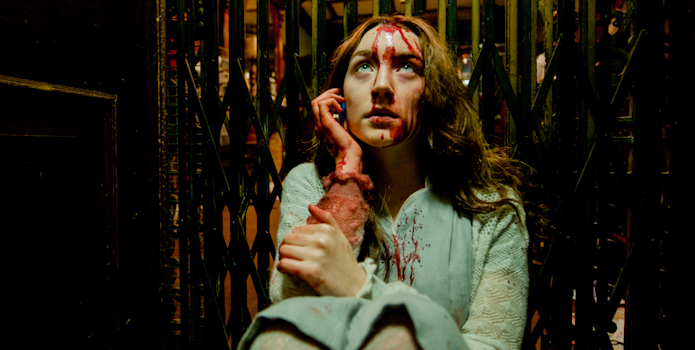
Clara is beautiful and sexually charged which makes it easier to take care of her sister and herself. This path leads her to Noel (Daniel Mays), a grieving man whose mother has passed and left him with the family business, a worn down guest house which shares the title of the film. It is here that the sisters take up residence and try to start anew. Soon after Eleanor meets Frank (Caleb Landry Jones), a strange boy working at a residency she has visited, and the two slowly develop a friendship. Eleanor is torn between her secretive lifestyle and her longing to break free of the loneliness that comes with living in isolation. It is these feelings that dictate the last two acts of the film as her honesty with humans allows the vampires in chase to locate her and Clara.
The vampires in Byzantium are revealed to be a brotherhood of men who don’t take too kindly to having their ritualistic and apparently quite sexist approach to choosing their brethren tampered with by the hands of a female. This is a boys club as it would seem, and obviously things are wrong as our two leads are females. The film is essentially a chase story, filled with lots and lots of exposition and dreams as we slowly learn the true nature of Clara and Eleanor’s relationship.

Again, there are many things to enjoy in Byzantium. The performances are all solid, with Gemma Atherton and Caleb Landry Jones as the two standouts. Johnnie Lee Miller continues a quietly sound career of adroitly making the audience hate the characters he plays, while I will say I am beginning to tire of Soiarse Ronan. The characters she portrays all play to the strengths of her skill set, which she needs to further develop. I began to notice this in Hanna and especially Violet and Daisy, a film from last year’s festival that I found to suffer from the same problems as this film.
Upon learning this was based on a play by Moira Buffini, I found myself surprised in her ability to expand the overall scale of her story, but this may have been all in the director’s hands. Regrettably, it felt as if the plot lacked the same expansion, and was more focused on the relationships and idiosyncrasies of its protagonists. That’s alright for some, but for a film that relies solely on exposition to progress the narrative, I felt the addition of a few tense or shocking sequences would have benefited the film greatly.

Director Neil Jordan has had such a long career, but it has been muddled by his last few, so much so that it may be hard to recall his last solid outing. I applaud his visual aesthetic and will continue to watch his films due to his fantastic understanding of the scripts he works with, I just think that he needs to start choosing better scripts. I prefer to give re-imaginings and re-interpretations a chance as opposed to ignoring them completely, and this is just one way it can go. I think fans of the genre will still enjoy Byzantium, but with respect to vampires everywhere, I like me some fangs and coffins!








 Entertainment Maven