Nicholas Rey – pronounced nicoLAH – is a French filmmaker whose newest offering is an unconventional adaptation of Gunther Anders’ posthumously published novel called The Molussian Catacomb. The director has chosen to adapt the novel despite not having read it because it has no French – nor English – translation. He thus has to rely on friends who read German and can recommend passages for him, his story about two prisoners recalling a man’s rise to power like an infamous 20th century European dictator.
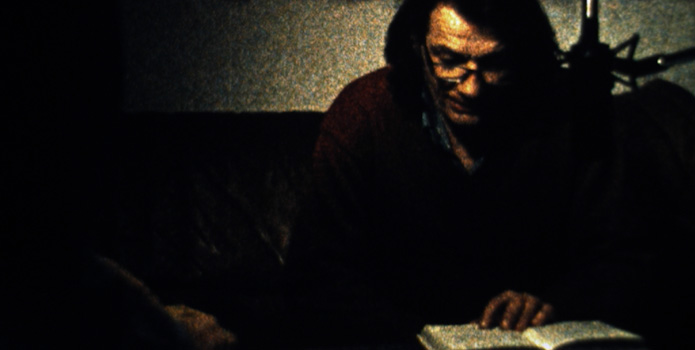
Under the Wavelengths program at this year’s Toronto International Film Festival, differently Molussia is made up of nine reels shown in random order. The movie’s aesthetic quality and/or lighting is under the mercy of 16mm stock, producing that sort of grainy look that makes the 2000’s or 2010’s look like the 1970’s. We the audience are hanging on to a few clues of place and context, the movie relying on mood and dread, and mostly relying on the recitation of the novel’s passages. The topics of the passages include deceit, blindness, frustration, irascibility, indifferent philistinism and anger – I don’t agree with the character talking about anger negatively, since anger to me means observation and a want for change. But what happens is that the characters about whom the voice over is speaking are changing for the worse.
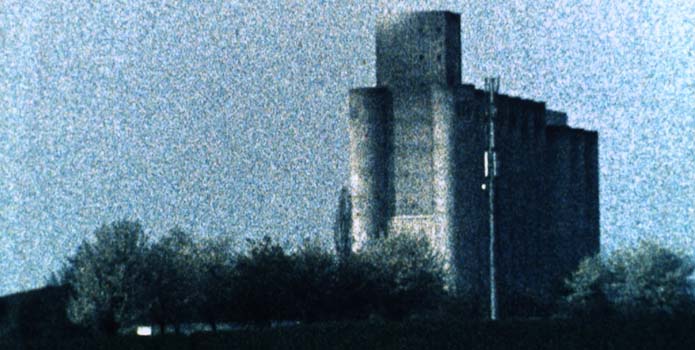
For full disclosure, despite taking a class on avant-garde cinema and having seen movies by Germaine Dulac and Man Ray, I have not seen avant-garde cinema of this generation. With this training I can understand Rey’s aims of depicting desolation and emptiness which are or seem to be the novel’s main themes. He chooses Tarkovsky-esque b-roll depictions of nature, shots of suburbia reminiscent of the houses in Jacques Tati’s movie Mon Oncle, and shots of empty factories. That list’s order is influenced by the order in which the reels were shown in my screening. Nonetheless, those images convey emptiness more than what we would have had with a conventional adaptation. The conversations take place in a catacomb, would be like 80 minutes of darkness. But cinema requires action and this movie does not have it. I’m not saying that all nine reels are universally stagnant. There are camera spins in some reels, buzzing sound design in others. The reels with static shots, however, are almost unendurable and anti-cinematic.
But again, let’s go back to Rey’s aims in making the film. They might not have made for the best movie going experience but keep an open eye and mind when you watch it. If it comes (back) in the English-speaking world, that is.
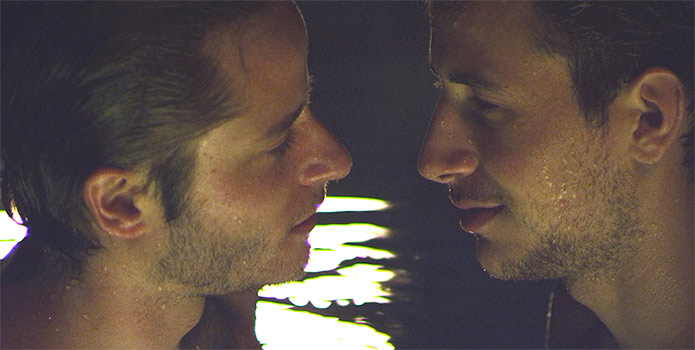
A gay Palestinian walks into a gay bar and finds his friends as well as someone new to the bar, a gay Israeli lawyer. There is no punch line. This will end well. Out in the Dark is one of those stories where the impossible happens. We almost question it but that only means that people like the gay Palestinian – his name is Nimr (Jacob) – who, despite of oppression, will find avenues of freedom. It’s surprising to know that this is Jacob’s debut performance because he and his co-star, Aloni, who plays the gay Israeli lawyer Roy, have great chemistry.
Their love, both in the bars and during privacy, is idealized and sweet, characteristics that may be attributed to a cultural expectation towards gay people to sanitize the depictions of their love. They’re the force of good in this movie, which they are. So evil, then, exists through close relatives who treat Nimr like he’s a stain in the family who has to be offed, or the bureaucratic and xenophobic Israeli officials. They’re one-dimensional characters, but that doesn’t make the two leads more efficiently human-like.
The way Nimr is written is also flawed, especially after he’s being hunted by both Palestinian and Israeli characters. If he doesn’t want to be found, why is he using his cellphone, or why are he and Roy making themselves look more conspicuous despite trying to hide? I suppose their slightly and arguably lax attitude towards these urgent matters make the movie less overwrought but this still doesn’t feel like a good compromise.
In Kiarostami’s most accessible work yet, we the audience are hearing a conflict-heavy, one-sided conversation while watching an escort named Nagisa, who looks happy while hanging out in a restaurant. Did this happen to her before the movie’s time line has begun? No, it’s happening across her, behind the camera, to her best friend and fellow escort Akiko, who is talking to her possessively weird boyfriend while also being strong-armed to ‘work’ tonight.
The camera captures this cagey situation and claustrophobic environment. This is Tokyo. We cannot move the walls back, Michael Cimino, despite wanting these characters to have some breathing room. This restaurant scene also shows how Kiarostami greatly uses both foreground and background, this exploitation happening in a public place where the background characters are indifferent to what’s so obvious to us.
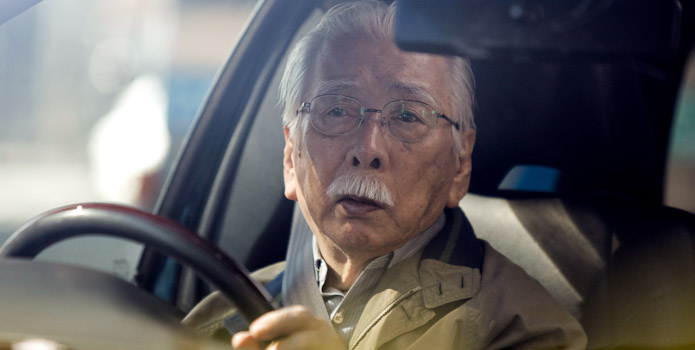
After delving into a few of Kiarostami’s works I thought that his colleagues are better, his work seemingly too cerebral, almanac-y and mysterious for me. Yes, the intellectual fabric within this movie is clearer after pondering over it, but this movie hits more on the psychological front and it delivers that blow subtly. There’s a scene where Akiko listens to her voicemails, part of a performance decided on being passive and receptive like her character always is, but Takanashi’s awareness of her sense and surroundings throughout the movie make her performance one of the best of the year. The rest of the movie shows us what would happen if she, her boyfriend and her client are cramped together in a car – a Kiarostami motif – the three of them participating in one of the quietest yet most shocking cluster fucks ever recorded in the history of cinema.
Starring Sheri Moon Zombie, Bruce Davison, Ken Foree, Patricia Quinn, Dee Wallace, Maria Conchita Alonso, and Judy Gleeson
Written and Directed by Rob Zombie
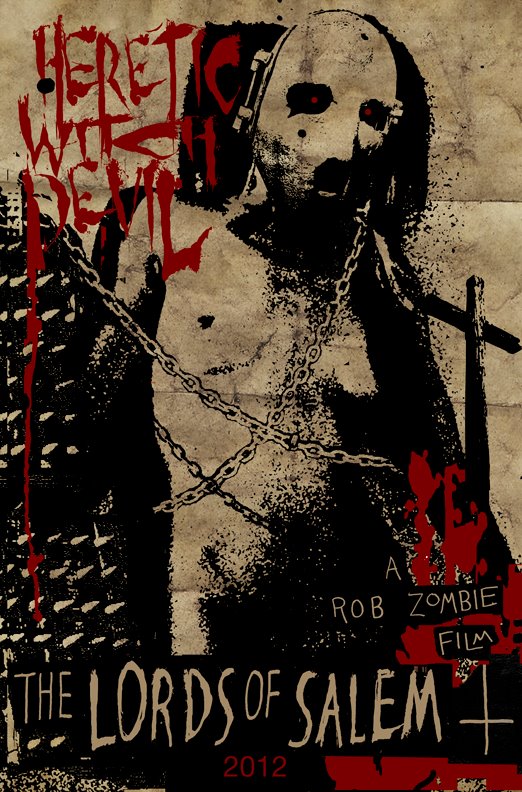
Midnight Madness, the midnight programme at the Toronto International Film Festival, has been a little lackluster for me so far. No One Lives and Hellbenders had some pretty serious script problems, while Seven Psychopaths didn’t captivate me in the same way that In Bruges did. The one saving grace thus far has been the incredible effects found in Dredd 3D. Film festivals are always a 50/50 affair in terms of quality movies, mainly due to the fact that the programmers can only select what is currently available to them. Looking at the back half of the lineup I see titles like The ABCs of Death, The Bay, and John Dies at the End, and I feel quite positive that my Midnight Madness experience will improve in the end. However, Rob Zombie’s The Lords of Salem was the on the docket for Monday night and given my less than stellar experiences with House of 1000 Corpses and Halloween, I was hoping The Lords of Salem would be drastically different from his previous projects.
The Lords of Salem is the story of a coven of Salem witches, the Lords, who were burnt at the stake in the past only to wreak havoc in the present day thanks to the last minute chanting of a curse. Heidi Hawthorne (Sheri Moon Zombie), a late night radio DJ for a heavy rock station appears to be the unfortunate victim, as she receives a wooden box at the radio station containing a haunting vinyl record by ‘The Lords’. Thanks to the effects of the music and a strange new neighbour on the floor of her apartment, Heidi becomes sleep deprived, begins to hallucinate, and generally falls apart at the seams. Her friends at the station are helpless and can only watch as the Lords of Salem tighten their evil grip on Heidi.
The Lords of Salem is characteristic of Rob Zombie’s incredibly visual style. There are a number of shots and scenes with beautiful colour schemes, particularly reds and golds, that are a treat to see on the big screen. Also present is Zombie’s inclusion of inexplicable horror: priests with melting, ashen faces, literally faces made of ash, are probably the highlight in this department as they certainly made me feel a little uneasy in my seat. Also of note is the performance by Sheri Moon Zombie. Although it may not be a groundbreaking performance, she manages to radiate charisma while onscreen and I would be shocked if there were members of the MM crowd who were not rooting for her as the Lords of Salem closed in. Unfortunately, that pretty much sums up my positive experience with Zombie’s new film.
For such a visual director I cannot understand why The Lords of Salem looked so amateurish in the photography department. I know next to nothing about film stock or digital cameras, but The Lords of Salem looked like it was filmed with a very low quality digital camera. I was familiar with the work of the DP on The Lords of Salem, Brandon Trost, and enjoyed his work on The FP, so I’m kind of at a loss to explain why Lords so cheap.
Probably the biggest problem with Lords was the writing and execution of the script. The story falls in the realm of class horror and as such, is incredibly basic. Given that Zombie is an experienced filmmaker, you would think that he would be able to do justice to the slow-burn tension that is needed in a story involving the rebirth of an ancient evil. But Lords of Salem crawls to the finish. From the uninteresting opening scene, in which the most frightening part is the nudity, to the final appearances of the witches in the present day, Lords of Salem is anything but scary or suspenseful.
During the Q&A we listened to Zombie explain that the idea for the movie had been in his head for five or six years. Really? The idea could not have been more complex than ‘a movie about witches’. Also, it was shocking to discover that well known actors such as Udo Kier, and Clint Howard had been cut-out of the final version of the movie. Zombie simply stated that they shot so much footage and couldn’t possibly fit everyone in. An alarm went off in my head as I heard this. It perfectly explained why the script felt so basic and yet still disjointed. This and other comments made it seems like Zombie prefers to be inspired and flexible while on the set or in the editing room, rather than have a well structured and polished script from the beginning. To each his own, but that makes me think that it is time for Zombie to put both feet firmly into the director’s role and collaborate with a writer on his next movie. There is no doubt that the man is talented as a visual director, but I don’t know if he can be an effective storyteller. Film is a collaborative process and I would love to see what Zombie can do with a competent script.
Starring Bradley Cooper, Jennifer Lawrence, Robert De Niro, Julia Stiles, and Chris Tucker
Directed by David O. Russell
Being a self-confessed football junkie, I have eagerly anticipated the latest film from David O. Russell, if not simply for the fact that the subject matter is something that I could easily relate to. To my surprise, I found so much to enjoy in The Silver Linings playbook that had nothing to do with the subject of football. Boasting strong performances from the entire cast (yes, that includes Chris Tucker), a perfectly written and assuredly directed feature from David O. Russell that falls in line with his best work.
We’re introduced to Pat Solitano (Bradley Cooper in a career defining performance) as he’s being released from a psychiatric facility in Baltimore into the care of his loving mother Delores (Jackie Weaver) and football obsessed father Pat Sr. (Robert DeNiro), who reside in Philadelphia. Philadelphia Eagles football is a cornerstone of the Solitano family, it is not only enjoyed for sport but also as Pat Sr. makes a modest living as a bookmaker. We learn that 8 months ago Pat had an explosion of violence in his home after discovering his wife’s infidelity, and as a plea bargain to avoid jail time, admitted himself into the care of said facility. Pat has been diagnosed with bipolar disorder, and it shows early and often. Pat is a complete mess, obsessively fixated on returning home and picking up his life where he left off. While reconnecting with his family and friends he meets Tiffany (Jennifer Lawerence), a widow who is avoiding the pain and emotions of her situation by masking her problems with sexual promiscuity. It is in Pats’ delusions of rekindling his marriage where a friendship between the two psychologically torn individuals is born and where the majority of the film takes place. This is not only a romantic comedy, but also a genuinely engaging story of one man’s personal redemption and discovery of self-worth.
This was the second performance from Bradley Cooper I have seen at this year’s festival and I was happy to see his potential begin to be realized. I have always liked him since I saw him all those days ago as a student on several iterations of Inside the Actors Studio. Here he is completely believable as a man who is barely grasping his reality and is unwilling to let go of his failed marriage, trying to fit it into the context of whatever situation he finds himself in. Bi-Polar disorder is a tremendously difficult illness to live with and one that is sometimes easily dismissed. Cooper’s realization of the illness is a strange mix of sadness, humour, rage, manic energy, and comic wit. I can also use that exact description to define the performance of Jennifer Lawerence. This is another fantastic role for the actress who is quickly ascending the Hollywood ranks through an eclectic mix of difficult indie roles and mainstream to blockbuster fare. Her excellent dramatic skills are only bested by her cagey and beautifully innocent looks. This seems like it has another Oscar nomination written all over it.
It is with the utmost happiness that I can inform you, not only did Robert Deniro seem to actually try to act with enthusiasm in Silver Linings Playbook, instead of traversing the script on cruise control, but his scenes are the best part of the film. The majority of the emotional moments for Pat in the story are shared with his father, and it is endearing to watch as Pat Sr. tries to reconnect with his son the only way he knows how, through their mutual love of football. In fact, football plays an important role in the narrative as many set pieces take place around the fact that an Eagles game is being played, or at Lincoln Financial Stadium for a wonderful scene later in the film. It is very telling to me that I enjoyed this film so much, considering the team featured in the film is the bitter rival of my beloved Dallas Cowboys.
Silver Linings Playbook is also filled with likable yet flawed supporting characters provided by the rest of the cast. Everyone from Pat’s psychiatrist (Anupam Kehr) to Tiffany’s sister Veronica (Julia Stiles) to Pat’s fellow mental patient Danny (Chris Tucker in his best performance since Baumont Livingston in Jackie Brown), everyone has a moment to shine and leave a strong impression that resonates throughout the runtime.
This is easily David O. Russell’s least stylized and most accessible film to date. I was quite happy that he seemed to want to be more faithful to the source material and hold back on bringing the material into his kind of film, although not without including some of his well documented zoom shots. Continuing to overcome his behind the scenes notoriety as a difficult artist to work with, his latest film is a excellent addition to an already great body of work.
Although it is clear by the end a romantic story is at the heart of Silver Linings Playbook, the film manages to strike a perfect balance of drama and humour that just about anyone can find something to love, much like its characters. It is rare that a romance unfolding over such a short time can be so organic and believable. Bravo to the filmmakers. This is a film that I look forward to revisiting in the future, I highly recommend checking this one out. Upon finishing this review it left me to wonder: the last time this David O. Russell made a romantic comedy (Flirting with Disaster), he followed it up with Three Kings, a film I consider a masterwork. I wonder what’s next on the horizon…
Starring Keira Knightley, Jude Law, Aaron Taylor-Johnson, Kelly Macdonald, Matthew McFayden, Olivia Williams, Michelle Dockery, Emily Watson, Holliday Grainger, Shirley Henderson, Alicia Vikander, Susanne Lothar, half of England and one-third of Europe.
Directed by Joe Wright
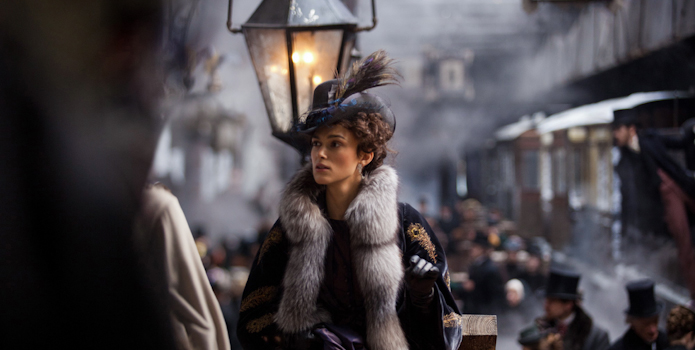
My joke on this post’s casting notes is a reference to a passage in one of the earlier chapters of Tolstoy’s Anna Karenina. The narrator informs us of a Stiva Oblonsky (McFayden), who knows half of Moscow and half of St. Petersburg. Which then reminds me of a line in Titanic probably said by Mrs. Dewitt-Bukater about the lifeboats serving only the good half of the ship. It’s as if ‘society’ is a shorthand term for the aristocracy and the bourgeoisie, and as if we, the descendants of the serfs, might as well not exist. I’m in the process of reading Anna Karenina and it’s a master class of cognitive dissonance, Tolstoy exposing the most repugnant examples of urbanite elitism. It’s the same society that will crucify a woman for making a man’s mistakes, especially one of adultery.
Earlier reviews have compared this adaptation of Anna Karenina to Powell and Pressburger or to Baz Luhrmann. But I see more of a resemblance to last year’s Hugo in the way that it exposes skeletal machinations and layers. Neither the colours nor the costumes can distract me from tasting the wood and the sweat of the backstage areas. Wright uses an exposed method of portraying the story on a meta-stage, and in doing so makes Tolstoy’s satire more pungent. If you take Wright’s method as flaws I will respectfully understand yet accept them for strongly bringing forth his message.
Populating this mise-en-scene is a great ensemble cast led by Knightley, who superbly externalizes snippets and varieties of emotion within seconds. Lastly, watch out for Vikander who plays Anna’s relative Kitty, the actress embodying perfection – she’s going to be a star if she plays her cards right.
Starring Juno Temple, Michael Angarano, Alexis Bledel, Alia Shawkat, Bobby Moynihan
Directed by Ramaa Mosley
It’s an attractive concept – what would characters in a movie do if they find an object that would give them money if they get hurt. In this movie it’s the titular brass teapot that finds its way in the hands of a one-time kleptomaniac named Alice (Temple), who is also an unemployed college graduate with an otherwise loving young marriage with John (Angarano). It’s reductive to say that this movie is just a way to watch actors hurt themselves physically. The movie thus responds to the challenge on where it would take its characters, what it would make them endure and how to keep this premise interesting for the next ninety minutes. Although its and our sadism is a big part of the movie, it also focuses on its shallow rewards of wealth and how it would change our leading couple.
There are, however, elements of this movie which are not as good. Specifically there’s Temple, an amazing character actress and supporting player who can’t cut it in a leading role. She is playing a character with written flaws, someone who is selectively greedy and abrasive, but I’ll give her credit for being creative. She, like this darkly humoured movie, takes us on a journey that helps us redefine pain and endurance. Some parts of the movie look too cheap and fluffy but the many physical gags in between will always work for viewers like me.










 Entertainment Maven